An AI chatbot is a software program that uses a large language model to hold a conversation in plain language: answering questions, following instructions, drafting text. An AI companion chatbot goes further. It's built around a persistent character with memory and an emotional frame, made for an ongoing relationship instead of one-off tasks. Pleasur.AI is the second kind, built for adults 18 and over.
That distinction matters more than it sounds, because most people meet the category through a general assistant and assume every "AI chatbot" is the same thing. It isn't.
ChatGPT became the fastest-growing consumer app on record, reaching an estimated 100 million monthly users about two months after launch. That's the tool most readers picture when they hear "AI chatbot": a general-purpose assistant you ask things. A companion chatbot is a different product wearing some of the same plumbing.
AI chatbot vs. AI companion: what's the difference?
The core difference is purpose. A general chatbot is a tool you use and close; a companion chatbot is a character you keep talking to. Both run on a large language model, the same family of technology that powers a generic chatbot, but they're tuned for opposite jobs.
A general assistant optimizes for accuracy and breadth. Ask it anything; it has no fixed identity and forgets you between sessions. A companion optimizes for continuity and character. It has a name, a personality you shaped, and a memory of what you've said.
It's the same reason an AI girlfriend isn't just a flirty prompt on ChatGPT: the assistant has no persistent persona and hard-blocks adult conversation at the policy layer. A companion platform is built the other way around.
What makes an AI companion different from a generic chatbot
Three things separate a companion from a generic chatbot: memory, emotional context, and personalization.
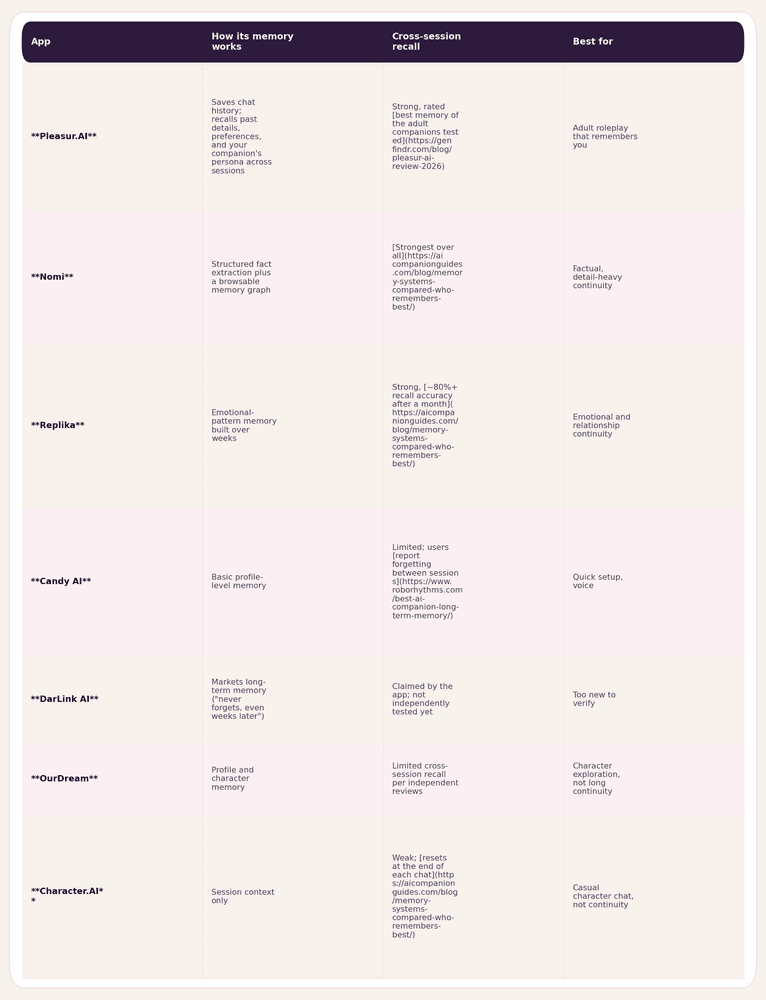
Memory. A general chatbot starts most conversations from zero. A companion stores what matters to you (names, preferences, ongoing storylines) and pulls it back into later chats, often from a vector store the model queries on demand. That's why an AI companion with long-term memory can remember a detail you mentioned two weeks ago. The continuity is the product.
Emotional context. A generic chatbot answers the question in front of it. A companion is tuned to track tone and respond to how you seem, not just what you typed. The conversation is the point, not a task to complete.
Personalization. With a general assistant, everyone talks to the same model. With a companion, you design the character (appearance, backstory, voice, conversation style) before you ever start chatting. That bundle of a named character, a persistent persona, and a chosen frame is what the "companion" label actually means.
This is also why people form real attachments to them. Replika, one of the larger companion apps, reports that roughly 60% of its paying subscribers describe a romantic relationship with their chatbot. That's not something users report about a productivity assistant.
Where Pleasur.AI fits, and how to try one
Pleasur.AI is an adult AI companion platform for users 18 and over. Instead of a single fixed assistant, you build a custom character with the AI Companion Creator: choose appearance, personality, backstory, and conversation style, then chat with that character one-on-one, with adult roleplay and fantasy supported within the platform's rules and safety boundaries.
If you've only used a general AI chatbot app, the difference is immediate the first time the character remembers something you told it last week. That's the line between a tool and a companion. You shape the character before you send the first message, and the relationship builds from there.
Frequently asked questions
Is an AI companion chatbot the same as a regular chatbot? No. Both use a large language model, but a regular chatbot is a general tool with no fixed identity and no memory of you between sessions. An AI companion is a persistent character with memory and an emotional frame, built for an ongoing relationship.
Does an AI companion remember past conversations? Yes, that's the defining feature. A companion stores relevant facts (names, preferences, ongoing storylines) and pulls them into later chats, so the character keeps a sense of who you are over time. A general assistant typically starts each session fresh.
Can ChatGPT be an AI companion? Not really. ChatGPT is a general-purpose assistant with no persistent persona, and it blocks adult conversation at the policy layer. You can give it a flirty prompt for a single reply, but it won't hold a character or remember you across sessions the way a dedicated companion platform does.
Is an AI companion chatbot safe to use? Reputable adult companion platforms restrict access to users 18 and over and set rules around what's allowed. No platform can promise perfect safety, so it's worth reading a service's privacy policy and content rules before you share anything personal. Pleasur.AI publishes its data practices and is built for adults only.
Do I need any technical skill to use one? No. You pick options — appearance, personality, voice, conversation style — through a guided setup, then start chatting in plain language. No prompt-engineering or coding is required.
The short version: a chatbot answers your questions, an AI companion remembers you. If the second one is what you came looking for, start building yours at pleasur.ai/create.