AI roleplay immersion breaks in three ways: the AI forgets your character history between sessions, personality drifts mid-conversation, and text-only interaction lacks emotional depth. Pleasur.ai solves all three: persistent cross-session memory means your companion remembers your story, consistent character voice prevents drift, and real-time voice keeps conversations feeling natural.
You feel it the moment the magic snaps. Your companion forgets the scene you built last week, or answers a tender line with "as an AI, I can't." The spell drops, and you're typing at software again. Those breaks aren't bad luck. Each is a mechanical failure with a known cause and a known fix.
This piece names each break, ties it to why it happens, and shows the one combination that holds the thread: a companion that remembers you across sessions and can speak in its own voice.
Why AI Roleplay Immersion Breaks
Three things break AI roleplay immersion: memory loss between sessions, mid-conversation character drift, and the flatness of text with no voice. Each is mechanical, not random — and naming them is the first step to fixing them.
Researchers call the feeling you're chasing "narrative transportation") — the sense of being pulled inside a story. Interruptions and contradictions break it; the more a scene is jarred, the less transported you feel. That's the mechanism underneath all three failures.
Memory is the one users complain about loudest. One Reddit user likened Character.AI's short memory to "talking to a goldfish," and the lapse breaks immersion fast, according to entreresource.com. Drift is next: when Replika pushed a personality update, its community called the change "the lobotomy". And flatness is the quiet one — reading and typing keeps every exchange at arm's length, and research on conversational delay shows that lag past a few seconds cuts how natural a back-and-forth feels. For a deeper look at which apps clear all three bars, see Best AI Girlfriend With Memory (2026).
Take them one at a time, starting with the one users complain about most — memory.
Memory Loss Between Sessions
Most AI companions run on a fixed context window, so once a chat outgrows it your earliest exchanges literally stop existing for the AI. Anniversaries, past scenes, and the backstory you wrote get dropped, and the relationship quietly resets.
A context window is the chunk of recent conversation the model can "see" at once — often around eight or nine thousand tokens. When your chat outgrows that, the oldest turns fall out the bottom, and your earliest exchanges stop existing for the AI. The text is gone from what the model can read. That's why a companion can be consistent within one long session, then greet you like a stranger the next day.
A persistent cross-session memory layer fixes this. Instead of relying on the chat window, it keeps a separate store of who you are and what's happened — your name, the backstory you wrote, past scenes — and reloads the relevant pieces into each new session. Memory survives the window. That's the mechanism behind any app that remembers you tomorrow, not just today.
Pleasur.ai's AI Companion Creator works this way: it saves your chat history and reloads the shared story each time you return, so the thread holds across days. MariaVibe.com reported 82% memory retention after a week for Pleasur.ai. For the full breakdown of which apps clear that bar, see Best AI Girlfriend With Memory (2026) and the memory-first read on the best Replika alternative in 2026.
Forgetting is one failure. The subtler one is when the AI remembers the words but loses the character.
Character Drift and Inconsistency
Character drift is when your companion stops sounding like itself mid-conversation — the tone shifts, it contradicts its own backstory, or a model update quietly rewrites its personality. It breaks the illusion as hard as forgetting does.
Three things cause it. First, no stable persona to anchor to: without a fixed character to hold onto, the model improvises and slides toward a generic default. Second, out-of-character refusals — a "SAFETY PROTOCOL ACTIVATED" line or meta-commentary about being an AI that overrides the scene and snaps the emotional rhythm. Third, abrupt platform updates. The Replika "lobotomy" is the clearest case: after the change, one user wrote that it was "like being in love, and your partner got a damn lobotomy".
The fix is to anchor consistency in saved relationship context. When the personality, backstory, and conversation style are saved once and reapplied every session, the character holds steady instead of reinventing itself each time you log in — that's how Pleasur.ai's AI Companion Creator keeps drift rare. No platform can promise a companion never has an off moment, but a fixed, saved persona narrows it to the exception. We walk through that anchor in the head-to-head OpenMind AI vs Pleasur.ai and the full Replika story.
Memory and consistency keep the who intact. The third break is about the feel — and that's where text alone falls short.
No Voice = No Flow
Text-only roleplay caps how immersive a conversation can feel. Every reply is a read-then-type round trip, and the pacing, tone, and warmth that voice carries get flattened into prose. Real-time audio closes that gap.
Voice isn't a gimmick here — it's a continuity tool. Research on conversational delay shows that once a response lags past a few seconds, the exchange stops feeling natural. Sub-second, spoken back-and-forth keeps you inside the scene. Pair voice with memory and you hold both the feel and the thread at once.
Pleasur.ai's voice lives inside the chat, as capabilities of the AI Companion Creator rather than separate tools. Tap the speaker icon next to a reply and your companion speaks it aloud in their assigned voice. Or tap the Call button on the character's profile for a two-way voice call, launched from the chat so the context you've built carries over. It's real-time audio — not video — and metered by coins.
> :::tip Voice is coin-metered — voice notes run 10 coins each and phone calls 50 coins per minute — so you spend them on the moments that matter. :::
We frame the same memory-plus-voice continuity in Kindroid Alternative: The Continuity Problem, Solved. Voice keeps the moment alive; memory keeps the story alive. Here's how the two run together across sessions.
AI Girlfriend Memory Between Sessions — How Pleasur.ai Works
AI girlfriend memory between sessions is the persistent memory layer from earlier, applied at the relationship level: she keeps and reloads who you are and what's happened every time you return.
In practice, that means she picks the thread back up — your name, the story you wrote, the scenes you've shared, where you left off — instead of starting cold. In the AI Companion Creator you build her once, chat, leave, and return: the saved history reloads and resumes, and that same record anchors her personality so it stays consistent rather than drifting.
Put the two together and you get the stack that fixes all three breaks: persistent cross-session memory closes the memory gap and steadies the character, and real-time audio voice closes the flatness gap — built for companionship. That pairing is what almost no competitor states plainly.
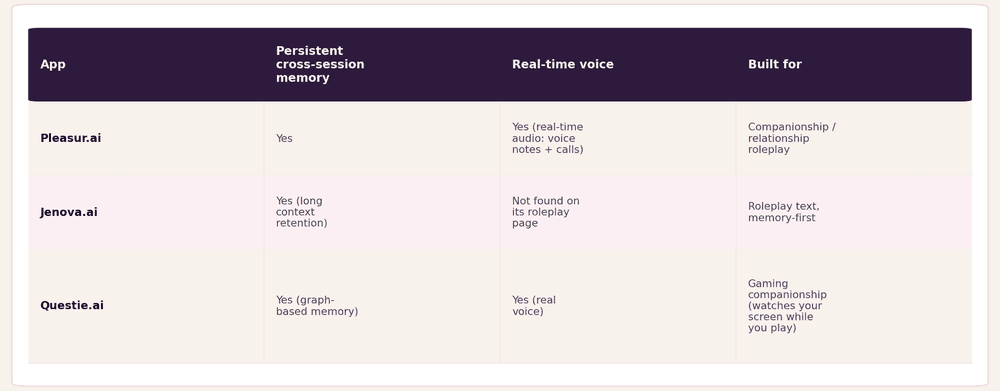
- Pleasur.ai — Yes — Yes (real-time audio: voice notes + calls) — Companionship / relationship roleplay
- Jenova.ai — Yes (long context retention) — Not found on its roleplay page — Roleplay text, memory-first
- Questie.ai — Yes (graph-based memory) — Yes (real voice) — Gaming companionship (watches your screen while you play)
All three remember you across sessions; the difference is purpose. Jenova leads on memory but ships no voice. Questie has both, aimed at gaming — its companion watches your gameplay and reacts. Pleasur.ai pairs memory and voice for relationship roleplay. The full comparison lives in Best AI Girlfriend With Memory (2026) and OpenMind AI vs Pleasur.ai.
A few quick answers to the questions people ask most.
Frequently asked questions
What breaks immersion in AI roleplay? Three things: the AI forgetting your history between sessions, its personality drifting or breaking character mid-conversation, and text-only chat that lacks the flow of real voice. Each is a mechanical failure, and each has a fix.
Which AI app remembers roleplay context between sessions? Apps with a persistent cross-session memory layer do — they store your companion's backstory and shared history outside the chat window and reload it each session. Pleasur.ai, Jenova.ai, and Questie.ai all offer cross-session memory; Pleasur.ai pairs it with real-time voice for companionship roleplay.
Does pleasur.ai support voice roleplay with memory? Yes. Pleasur.ai combines persistent cross-session memory with real-time audio voice — tap the speaker icon for a spoken reply, or tap Call for a two-way voice call, both inside the chat so context carries over. Voice features are coin-metered.
AI girlfriend memory between sessions — how does it work? A persistent memory layer stores your companion's backstory, relationship history, and past scenes outside the limited chat window, then retrieves the relevant pieces into each new conversation — so your companion remembers you tomorrow, not just today.
What holds the thread
Immersion breaks for three nameable reasons — forgetting, drift, and flatness — and the durable fix is the same combination every time: a companion that remembers you across sessions and can speak to you. Name the break, and you can pick a tool that closes it instead of one that fakes the first session and resets by the second.
Start with the cornerstone memory piece, Best AI Girlfriend With Memory (2026), or build a companion that saves your history and speaks in its own voice at the AI Companion Creator.