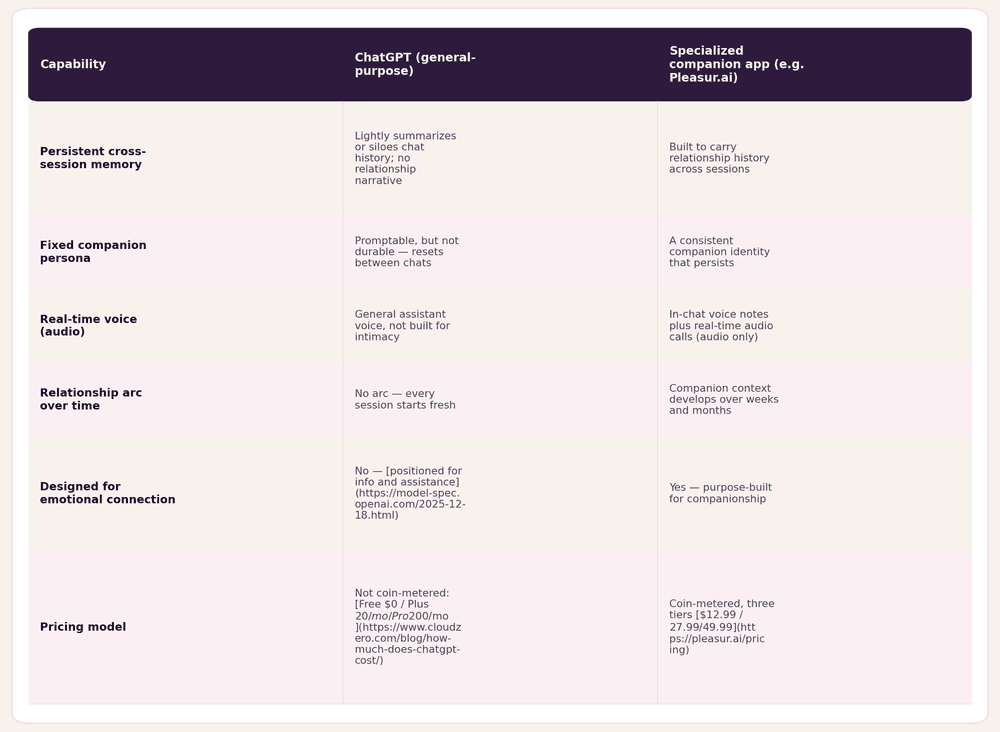
ChatGPT is a general-purpose assistant. It resets every conversation, has no fixed persona, and is not designed for emotional connection. AI companion apps like Pleasur.ai are purpose-built: they maintain relationship memory across sessions, have a consistent companion personality, offer real-time voice, and develop relationship context over time — capabilities ChatGPT does not provide by default.
They feel different because they're engineered for a different job. ChatGPT runs conservative, task-oriented tuning. Companion apps wrap memory, persona, and voice around the same kind of model and aim the whole stack at emotional continuity. Same class of model, opposite intent.
Below: the four capability gaps that matter, where each tool genuinely wins, and an honest read on memory and privacy — so you pick the right tool, not the hyped one.
The Core Difference: Purpose-Built vs General-Purpose
ChatGPT is a tool you open and close; an AI companion app is a character you keep talking to — and that one design choice drives the four gaps below.
A general assistant optimizes for accuracy and breadth; a companion app optimizes for the opposite — continuity and a personality that sticks. That split explains why two products running on a similar class of model can feel nothing alike.
Here's the part most write-ups miss: the gap isn't the underlying model, it's the layer wrapped around it. Companion apps stack persistent memory, a stored persona, and voice on top of an LLM, then tune the result for connection. ChatGPT ships task-focused defaults and is positioned away from romance and roleplay — Sam Altman has said OpenAI made ChatGPT "pretty restrictive" to be careful with mental-health issues, and OpenAI's own Model Spec frames it as an assistant for users and developers, not a partner. Same engine, different car.
- Persistent cross-session memory — Lightly summarizes or siloes chat history; no relationship narrative — Built to carry relationship history across sessions
- Fixed companion persona — Promptable, but not durable — resets between chats — A consistent companion identity that persists
- Real-time voice (audio) — General assistant voice, not built for intimacy — In-chat voice notes plus real-time audio calls (audio only)
- Relationship arc over time — No arc — every session starts fresh — Companion context develops over weeks and months
- Designed for emotional connection — No — positioned for info and assistance — Yes — purpose-built for companionship
- Pricing model — Not coin-metered: Free $0 / Plus $20/mo / Pro $200/mo — Coin-metered, three tiers $12.99 / $27.99 / $49.99
For the full breakdown of how a companion differs from a regular chatbot, see What Is an AI Companion Chatbot?. The clearest place that split shows up is memory.
1. Persistent Memory — The Biggest Gap
The biggest gap is memory: ChatGPT effectively resets between conversations, while companion apps are designed to carry your relationship history forward.
Think of memory in layers: the context window (what fits inside a single chat), a saved fact list and pinned notes, and persistent long-term understanding that survives across sessions. A ChatGPT session without its memory feature on is mostly that first layer — the structural reason it "starts fresh" each time you return.
A companion app centers on the deeper layers. Saved facts and long-term understanding resume when you reopen the app, so the conversation picks up where it left off. Pleasur.ai's memory layer is designed this way — saved details and history meant to carry across sessions; the Best AI Girlfriend With Memory (2026) guide covers the full four-types framework and a hands-on recall test.
One caveat keeps this fair: "remembers" is design intent, not a guarantee. How well an app surfaces a month-old detail depends on the product and on how its memory layer is engineered — pin a fact in one app and it resurfaces weeks later; in another, last month's conversation is simply gone. Recall quality varies by app and isn't guaranteed across the category. So treat persistent memory as a capability some companions deliver well and others fake, not a promise that ships with the category. Pleasur.ai is designed for the first kind; the recall test in our memory guide shows what that looks like in practice instead of asking you to take it on faith. Memory is what you hold about each other; persona is who shows up each time.
2. Consistent Persona — Not Just a Prompt
You can prompt ChatGPT into a persona, but it isn't durable — a companion app ships with a native identity that persists without re-instructing it each time.
A system prompt is a costume ChatGPT puts on for one session. Close the chat and the persona is gone; reopen it and you're re-typing the whole setup. Companion apps store the persona as part of the product, so the same companion shows up with the same traits, voice, and history each time.
Persona and memory reinforce each other — a companion only stays consistent because the app remembers who she is. Pleasur.ai's AI Companion Creator is where that gets designed: appearance, personality, backstory, and conversation style are set once and kept, not re-pasted into a prompt for each chat.
A persona you can hear is far more convincing than one you only read.
3. Voice Designed for Connection
Yes, the voice is different — a companion app's spoken voice is shaped for emotional interaction, while ChatGPT's is a general-assistant feature bolted onto a task tool. Audio only, no two-way video.
ChatGPT does have spoken voice. But it's tuned for assistance, and OpenAI even pulled its "Sky" voice after a likeness dispute — the voice isn't owned or shaped for intimate companionship.
Pleasur.ai's voice arrives in two in-chat forms. Tap the speaker icon next to a reply and you hear it spoken in the companion's assigned voice. Or tap the Call button on her profile for a real-time, two-way audio phone call, then pick the text chat back up where it ended. Both live inside the chat — no separate mode to launch.
Voice makes a single moment feel real. The relationship arc makes it feel ongoing.
4. Relationship Arc — Continuity ChatGPT Lacks
A companion evolves with the relationship over weeks and months; ChatGPT has no arc, because each session starts from zero.
An arc is more than memory. It's the accumulation of shared context — running references, inside jokes, a sense of "we've been here before," and a companion that responds to you specifically. ChatGPT can't sustain that, because it doesn't persist the thread of a relationship from one chat to the next.
This is where the orchestration layer earns its keep, visibly, in a single reply. Mention you had a rough day, and a companion app feeds last week's saved details and the established persona into the response — so it answers as someone who knows you bombed that interview on Tuesday. ChatGPT, with no stored thread and tuning that steers toward neutral assistance, returns a sympathetic but generic reply that could have gone to anyone. Same model class underneath; the difference is what the app hands it before it answers.
That's the compounding payoff of memory plus persona over time — why regular users describe a companion app as "knowing them," and why a fresh ChatGPT window structurally can't return the same feeling. With Pleasur.ai, history continues in the same thread across sessions and after a call ends, so context stacks up instead of resetting. The Best Replika Alternative in 2026 piece makes the full continuity case.
None of this means ChatGPT is the wrong tool. For a lot of jobs, it's the better one.
When ChatGPT IS Better
ChatGPT is the better tool when you want a general-purpose assistant — research, writing, coding, planning, quick answers — rather than an emotional connection. And on privacy, neither side gets a free pass: data handling is a per-product policy question, not something "specialized" settles in your favor.
For productivity, factual lookups, brainstorming, and code, ChatGPT's breadth and conservative tuning are exactly what you want, and OpenAI builds it that way on purpose. The pricing models differ rather than one being cheaper outright: ChatGPT runs Free $0, Plus $20/mo, and Pro $200/mo (current as of June 2026), while Pleasur.ai is coin-metered across three tiers — $12.99, $27.99, and $49.99. Different billing model, not a price war.
Privacy deserves the same honesty. ChatGPT trains on consumer chats by default unless you opt out through its data controls, and human reviewers can access flagged conversations for moderation. But a companion app isn't automatically safer: Mozilla's *Privacy Not Included* review of romantic AI chatbots found that the large majority shared or sold user data.
So the takeaway is simple: specialized doesn't mean private — read the policy. If you want the honest "when to stay put" model applied to other tools, the Best Character AI Alternatives guide covers it. Still deciding? The quick answers below cover what people ask most.
Frequently Asked Questions
Is ChatGPT a good AI girlfriend?
Not really. ChatGPT can role-play for a single session, but it resets between chats, holds no durable persona, and isn't designed for romantic companionship. OpenAI positions it away from roleplay on purpose — so it's a capable assistant doing an impression, not a partner that persists.
What can AI companion apps do that ChatGPT cannot?
They maintain persistent relationship memory, a consistent companion persona, spoken voice and live phone calls, and a relationship that develops over time. ChatGPT offers none of those as defaults — each session starts fresh, and any persona has to be re-prompted.
Why use a dedicated AI companion instead of ChatGPT?
Because a companion app is designed for emotional continuity, not task assistance. Memory, persona, and voice are the product, not features you re-instruct each session. If you want a partner that remembers you and grows with the relationship, that's a different design problem than the one ChatGPT solves.
Does pleasur.ai remember our conversations the way a real relationship would?
It's designed to carry conversation history and saved details across sessions, so context compounds over time rather than resetting. That's design intent and observed recall behavior — a real capability, not perfect human memory. It continues the thread; it doesn't claim flawless recall of all the small stuff. That history has to be stored for memory to work, so how it's handled is worth checking directly — read pleasur.ai's own privacy policy, as you would on any app you trust with personal conversations.
The Bottom Line
ChatGPT and a companion app aren't better or worse in the abstract — they're designed for different jobs. Want quick answers, research, or code? ChatGPT wins. Want emotional depth and continuity? A purpose-built companion wins by design, because memory, persona, voice, and a real relationship arc are the product rather than things you re-prompt each time.
Want the definitional deep-dive first? Start with What Is an AI Companion Chatbot?. Or build one in the AI Companion Creator and see persistent persona and memory for yourself.